Hyperion – Titan God of Heavenly Light & Pillar of the East
Hyperion is a Titan, one of the old gods who ruled before the Olympians. The god of light, he is the son of Uranus, or heaven and Gaea, or earth. Hyperion in turn is the father of the sun, Helios; the moon, Selene and the dawn, Eos. His wife was Theia, who was also a Titan, his sister and the goddess of sight and the blue of the sky.
The Origin of His Name: Watching from Above
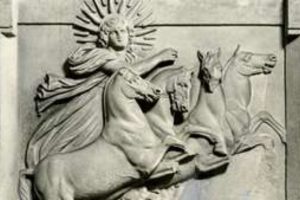
Hyperion’s name comes from the Greek for “the one who watches from above.” He is said to be the first to understand the cycles of the sun, the stars, the moon and the dawn or to even have ordered them in the first place. He was said to be breathtakingly beautiful.
The Twelve: Brothers and Sisters of Immense Power
There were twelve Titans. Hyperion had five brothers and six sisters. The Titans, as their name suggests, were giants. Powerful in both strength, wisdom and their knowledge of ancient magic and ritual, they lived on Mount Orthrys, a real, 5663 foot mountain found in the center of Greece.
The Imprisonment by Uranus
Uranus imprisoned the Titans in Tartarus, a murky place found beneath Hades. He seemed to have done this as soon as each of the children were born. Hyperion conspired with his brothers and Gaea, who was angry at the imprisonment of her children, to overthrow him. When Uranus went to visit their mother, Hyperion, Crius, Coeus and Iapetus went to the four corners of the earth: Hyperion to the east; Crius to the south; Coeus to the north and Iapetus to the west.
They held their parents apart and set upon their father. They held him while their other brother, Cronus, castrated him with a sickle Gaea had made. The Gigantes, Meliae, Erinyes and in time, Aphrodite, sprang from the blood of this mutilation. The Titans then dragged Uranus down to Tartarus and chained him there, but Uranus cursed Cronus and told him he too would be overthrown by his children.
The Rise and Fall of the Titans
The Titans reigned long enough to give birth to other Titans. But Cronus, who was mindful of his own father’s curse, re-imprisoned his brothers in Tartarus over time, where they were guarded by the one-eyed giant Cyclopes and monstrous giants called the Hecatoncheires. Because the Cyclopes and the Hecatoncheires were the children of Gaea and Uranus, they were the full brothers of Hyperion and the Titans. The Hecatoncheires had fifty heads and one hundred hands. In some tales, the sight of them appalled Uranus so much that when they were born he shoved them back into Gaea’s womb, which caused her no little distress. This was when she started to plot her husband’s destruction in earnest.
Cronus, fearful of his father’s prophesy, swallowed his own children by his sister Rhea as soon as they were born. These were the Olympians. He ate all of them but Zeus, who was hidden away by his mother. When Zeus was old enough, he pretended to be a servant boy and gave Cronus a drink that made him vomit up the other children.
Eventually, the Olympians overthrew the Titans in a terrible, decade long war called the Titanomachy. In some stories, Hyperion does not seem to have played much of a role in this war, though he supported the Titans who fought against their nieces and nephews. In other stories, he led the fight when Cronos was defeated and fought valiantly, even though the Titans still went down to defeat.
The Aftermath of the War
When the war was over, Hyperion and the other Titans were cast again into Tartarus, where they were once more guarded by the Hecatoncheires, who had sided with the Olympians.
While Hyperion and the other Titans languished in Tartarus, their roles in ruling the cosmos were taken over by the Olympians, including Zeus, Hera, Demeter, Hades and Poseidon. The Titans became literally the pillars that held up the earth and the sky, though in some tellings Zeus, the chief of the gods, released them.
Symbols of Hyperion
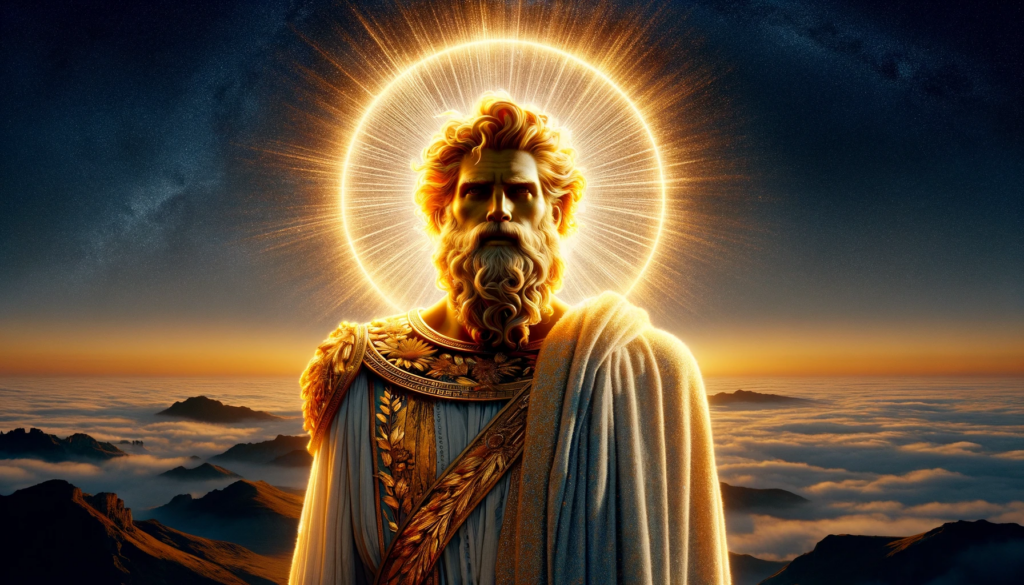
Hyperion is often associated with symbols that reflect his connection to the sun and light. One of the most prominent symbols is the Sun itself, representing his role as the father of Helios, the sun god. This symbolizes Hyperion’s influence over the light and the cycles of day and night.
Another similar symbol to this, again involves the sun, but is the ‘Wheel of the Sun’. This wheel, often depicted with radiant beams, signifies the journey of the sun across the sky, a path believed to be first understood and ordered by Hyperion.
As the Titan God of Heavenly Light, Golden Rays are also a symbol tied to Hyperion. These radiant beams of gold represent the light and clarity that Hyperion brings to the world. Illuminating the earth and the sky. This extends to the idea of enlightenment and knowledge, as Hyperion was known for his wisdom.
Children of Hyperion
Hyperion, together with his wife Theia, had three significant offspring, each playing a crucial role in the Greek mythological cosmos.
Helios
The Sun God, is perhaps the most famous child of Hyperion. Helios was often mentioned as driving his chariot across the sky, bringing daylight to the world. His daily journey from east to west was a very important aspect of ancient Greek daily life. It was a journey celebrated in lots of myths and stories.
Selene
The Moon Goddess, is another child of Hyperion. She is often depicted as a beautiful woman who, like her first born brother, rides a chariot across the sky. Selene’s chariot is usually silver and pulled by horses or bulls. Her role was to light up the night sky, and she was associated with the different phases of the moon,. These were important cycles for timekeeping, traveling and agriculture in ancient Greece.
Eos
The Goddess of Dawn, is the third child of Hyperion and Theia. Eos is described as bringing the first light of day, opening the gates of heaven for the sun to rise. In myth and antiquity, she is often depicted as a gentle bringer of light, renewing the world with the dawn of every morning .
Hyperion vs. Helios
Some people confuse Hyperion with his son Helios. Both were sun gods, but in different ways. Helios was the god who drove a chariot drawn by four horses across the sky every day.
Hyperion and his brothers were believed to have cooperated in the creation of human beings, and each one gave humankind a gift. Hyperion’s gift was sight.
Link/cite this page
If you use any of the content on this page in your own work, please use the code below to cite this page as the source of the content.
Link will appear as Hyperion: https://greekgodsandgoddesses.net - Greek Gods & Goddesses, February 7, 2017