Greek Goddess of Agriculture, Fertility, Sacred Law and the Harvest
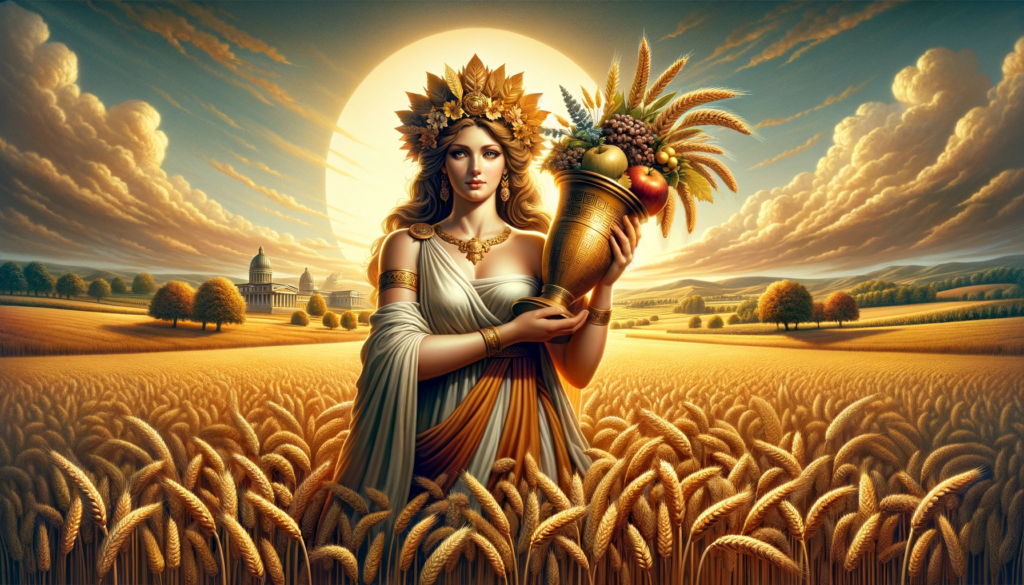
Demeter is the goddess of the harvest and presides over grains and the fertility of the earth. Although she was most often referred to as the goddess of the harvest, she was also goddess of sacred law and the cycle of life and death.
She is a very important deity in the Greek pantheon, embodying the life-giving aspects of nature and overseeing the cycles of life, death, and rebirth. Her myths and worship reflect the ancient Greeks’ deep connection with the land and their understanding of the delicate balance of the natural world.
Demeter’s influence extended into the realm of sacred law and rites, particularly through the Eleusinian Mysteries – a series of large and secretive concerts held every five years. These mysteries represented the abduction of Persephone by Hades in three phases. The “descent” (loss), the “search” and the “ascent”. The main theme is the “ascent” of Persephone and the reunion with her mother. These secretive and mystical rites, held in her honor, promised initiates guidance for a blessed afterlife.
Demeter’s Siblings
As a daughter of Cronus and Rhea, Demeter’s siblings include Hestia, Hera, Hades, Poseidon, and Zeus. These were all important Olympian Gods with rich mythology and cultural importance. Each representing a fundamental aspect of the ancient Greek belief system. Demeter’s role being primarily associated with agriculture and fertility.
Demeter’s Consorts
The romantic life of Demeter is marked by few significant relationships, with both Gods and mortal men. The relationships amongst the gods can be quite incestuous and so it might come as no surprise that two of her most significant partnerships are with her brothers Poseidon and Zeus. Her other most notable consort was the mortal man Iasion (or Iasius), a mortal hero. He was the son of Elektra and Zeus, or according to some accounts, Corythus.
Her relationship with Poseidon was not one of love, rather it was brutal and violent. Demeter, fleeing from Poseidon’s unwanted advances, transformed herself into a mare to hide from him. However, Poseidon, wasn’t fooled by her disguise, transformed himself into a stallion and pursued her. He then forcibly fathered two children with Demeter: Despoena, a nymph, and Arion, a talking horse.
Her relationship with Zeus brought Persephone into the world, her most well-known child.
Demeter’s Children
Demeter’s children include Persephone, born from Zeus, who plays a central role in the myth of the seasons. Her other godly offspring are Despoina, and the horse Arion from Poseidon. Her union with the mortal Iasion at the marriage of Cadmus and Harmonia resulted in the birth of twins Ploutos and Philomelus.
By some other accounts, she may also be the mother of Iacchus, Hecate and Acheron. Each of these connections is more ambiguous though. Each contested with alternative parents also mentioned for each across different myths.
Symbols and Items Associated with Demeter
Demeter is often depicted with symbols and items that reflect her dominion over agriculture and the harvest. While she was also the goddess of sacred law, it is with the more earthly and attractive areas of her rule that she is usually depicted. These include the cornucopia, ears of corn, a sheaf of wheat, a torch, and occasionally, a crown of flowers. She is often depicted with at least one of these items in hand or close by in painting and sculpture.
Sacred Animals
The sacred animals associated with Demeter include quite an eclectic mix. Pigs and serpents are the most commonly associated with this goddess. Geckos are also mentioned in the myths around Demeter, notably because she would show favor to those that killed the little lizards. Turtledoves, cranes, and screech owls are also mentioned, but with little supporting mythology. Other than their representing various aspects of agriculture, fertility, and the natural world that she governs.
Myths Surrounding Demeter
The Abduction of Persephone
One of the most poignant and significant myths involving Demeter is the abduction of her daughter, Persephone, by Hades, the god of the Underworld. This event is central to understanding Demeter’s role and influence. Persephone, while gathering flowers in a field, was seized by Hades and taken to his realm. Demeter roamed the earth, endlessly searching for her, preoccupied with loss and grief. Her sorrow was so great that it led to the neglect of the land. Angry over the abduction, Demeter subjected the world to famine. The seasons halted with the onset of winter, and living things stopped growing and died.
Zeus sent the gods to Demeter one by one to try and bring her out of her despondency. Eventually he sent his messenger Hermes to the underworld to bring Persephone back and prevent the extinction of all life on Earth. Demeter and Persephone were ultimately reunited at Zeus’s decree.
Hades agreed to Persephone’s relief but gave her a pomegranate as she left. When she ate the pomegranate seeds, she was bound to him for a period of the year, either the dry Mediterranean summer, when plant life is threatened by drought, or the autumn and winter.
Demeter was granted four months per year with Persephone; her daughter would remain with Hades for the remaining months.
Punishment of Erysichthon
In this myth, the wrath of Demeter, and her connection to sacred law are central. Erysichthon, a man who showed blatant disrespect for Demeter by cutting down her sacred grove, was punished severely by the goddess. In punishment for his behavior, she inflicted upon him an insatiable hunger. No matter how much he ate, he was never satisfied. He exhausted all his wealth to try and satisfy his never-ending appetite and eventually consume himself. The consequences of impiety and disrespect towards the gods and nature, were deemed to be severe. This myth emphasizes the importance of honoring the sacred laws.
Demeter and Iasion
The affair between Demeter and Iasion occurred at the wedding of Cadmus, the founder of Thebes, and Harmonia, the daughter of Ares and Aphrodite. This event was a big celebration, attended by many gods and goddesses. During the festivities, Demeter was struck by the charm and beauty of the young, mortal Iasion.
Their union took place in a thrice-plowed field, a setting symbolizing fertility and the cultivation of the earth. This act was not just a moment of passion but also a symbolic gesture linking Demeter, the goddess of agriculture, with the mortal realm through Iasion. Their affair resulted in the birth of two significant sons: Ploutos, representing wealth, and Philomelus, the patron of plowing and agriculture.
This affair between a goddess and a mortal man, however, did not go unnoticed or unpunished. Zeus, despite his own dabbling with mortal partners, and for reasons that vary among sources, struck down Iasion with a thunderbolt. This act of Zeus can be interpreted in several ways. It might represent the divine order’s response to a breach of the natural law. Alternatively, it could reflect Zeus’s jealousy or his role as the upholder of the cosmic order, where such unions were deemed inappropriate.
Nursing of Demophoon and Triptolemus
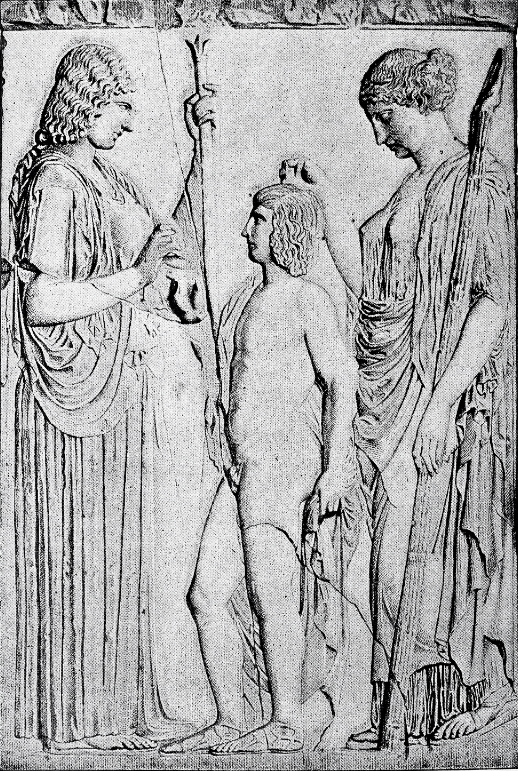
In her wanderings, searching for Persephone, Demeter arrived at the court of King Celeus in Eleusis, where she was welcomed and given refuge. Out of gratitude, she agreed to nurse the king’s young sons, Demophoon and Triptolemus. She fed Triptolemus breast milk for his sickness, and he recovered his strength. He also instantly became an adult man.
In treating Demophoon, she wanted to immortality upon him. She anointed him with ambrosia and placed him in fire every night, symbolizing the purging of mortal elements. However, this ritual was interrupted by Metanira, Demophoon’s mother, who misunderstood Demeter’s intentions, unaware of her godly identity.
Demeter, in an expression of anger, revealed her true identity, but also provided the people of Eleusis with the knowledge of her sacred rites. This laid the foundation for the Eleusinian Mysteries. A central theme in the story of Demeter and her daughter Persephone.
Demeter and Triptolemus
In another myth including Triptolemus, one of the princes of Eleusis, Demeter taught him the art of agriculture. She gave him a chariot drawn by serpents and sent him across the land to disseminate this knowledge. This myth highlights the nurturing aspects of Demeter’s godly role. Not only through the provision of sustenance but also through the sharing of vital knowledge. It underscores the cultural and spiritual significance of agriculture in ancient Greek society, linking it directly to the divine.
Facts about Demeter Summarized
- Demeter was the daughter of Cronos and Rhea.
- She was the goddess of harvest and fertility.
- She had one daughter, Persephone; Zeus was Persephone’s father.
- She revealed to man the art of growing and using corn.
- Only women attended the Thesmophoria, a fertility festival held in honor of Demeter.
- The fields of grain and the threshing-floor were under her protection. They were temples at which she could occupy at any moment.
- Her chief festival came at the harvest time. It began as a humble feast and over time morphed into a mysterious worship. This great festival occurred only every five years.
- Demeter and Dionysus were worshipped at Eleusis, a little town near Athens. Their worship was referred to as the Eleusinian Mysteries.
- Demeter was older than Dionysus. They were the two great gods of the Earth.
- Metaneira, a mother herself, comforted Demeter in Persephone’s absence. In fact, Demeter nursed one of Metaneira’s children. She doted on the child and anointed him with ambrosia on a daily basis. Demeter’s attachment to the child alarmed Metaneira, and the two ultimately went their separate ways.
- Men called Demeter the “Good Goddess” despite the desolation she had brought about as a result of her grief.
- She named Triptolemus her ambassador to men, and taught him along with his brother Celeus, her sacred rites.
- In ancient art, Demeter was pictured wearing a wreath made of ears of corn.
- The snake and the pig were most sacred to her.
- The torch is often depicted in connection with Demeter because of her persistent search for Persephone.
- Demeter came to Eleusis during the reign of King Erechtheus of Athens.
Link/cite this page
If you use any of the content on this page in your own work, please use the code below to cite this page as the source of the content.
Link will appear as Demeter: https://greekgodsandgoddesses.net - Greek Gods & Goddesses, September 19, 2014